
The Battery Bubble
Batteries won't save the grid


Battery storage has long been touted as the solution to wind and solar intermittency—or the variable nature of wind and solar electricity production.
A recent report co-authored by one of the Bad Boys, Mitch Rolling, and Jonathan Lesser, Ph.D., for the National Center of Energy Analytics (NCEA), put this to the test. The report, Batteries and the Grid: Hype, Hope, and Economic Reality, modeled how much battery capacity it would take to maintain reliability on PJM, the nation’s largest regional transmission operator (RTO), using primarily wind and solar to power the grid.
The short answer is that it would take an incredible amount of battery storage capacity to firm a mostly wind and solar PJM—even with the existing nuclear fleet staying online—and the cost to construct these facilities would be prohibitively expensive to achieve.
The enthusiasm surrounding battery storage—and what many people believe it can achieve—is creating a "Battery Bubble." The rapid growth of batteries has been fueled by battery procurement mandates in 13 states, subsidies, and overly optimistic narratives that ignore the physical and economic realities of what battery storage is capable of.

Critics like Jigar Shah claim the report modeled a solution that no one is calling for, but we would simply ask: where has Jigar Shah been recently? OR what planet is he living on?

Not only do numerous states have 100 percent clean and renewable energy mandates, some of the largest advocacy organizations and voices in the environmental world are still calling for 100 percent renewables, no new fossil fuel generation, and rapid retirement of the existing fleet.
Not to mention, the Biden administration that Shah worked for at the DOE said it wanted a carbon-free electric grid by 2035. That same administration made it extremely difficult to build fossil fuel generation of any kind, while incentivizing the expedited retirement of existing plants.
We’ll get to all this and more below.
Why Battery Storage
The grid was built to maintain reliability even when demand is at its greatest. This is why traditional energy sources like coal, natural gas, nuclear, oil, and hydro have worked so well for so long—they can all increase or decrease output to meet demand. With an adequate reserve margin, this system was so successful that blackout and shortfall events were almost always caused by transmission and distribution failures rather than an inadequate supply of generation.
This is no longer the case, thanks in large part to the “energy transition.” But the transition has a major issue—wind and solar resources can’t ramp up generation to meet demand, and as we discussed last week, they often aren’t producing any electricity whatsoever during peak demand hours.
One of the proposed solutions for firming wind and solar generation is by using battery storage. The thinking goes like this: if the grid can capture excess wind and solar generation when demand is low using battery storage technologies, it can divert that generation to peak demand hours and maintain reliability.
This sounds good on paper, but the limitations become clear once you model the numbers.
Why PJM
The U.S. grid is made up of several regional grids, some of which are organized by regional transmission operators (RTOs).
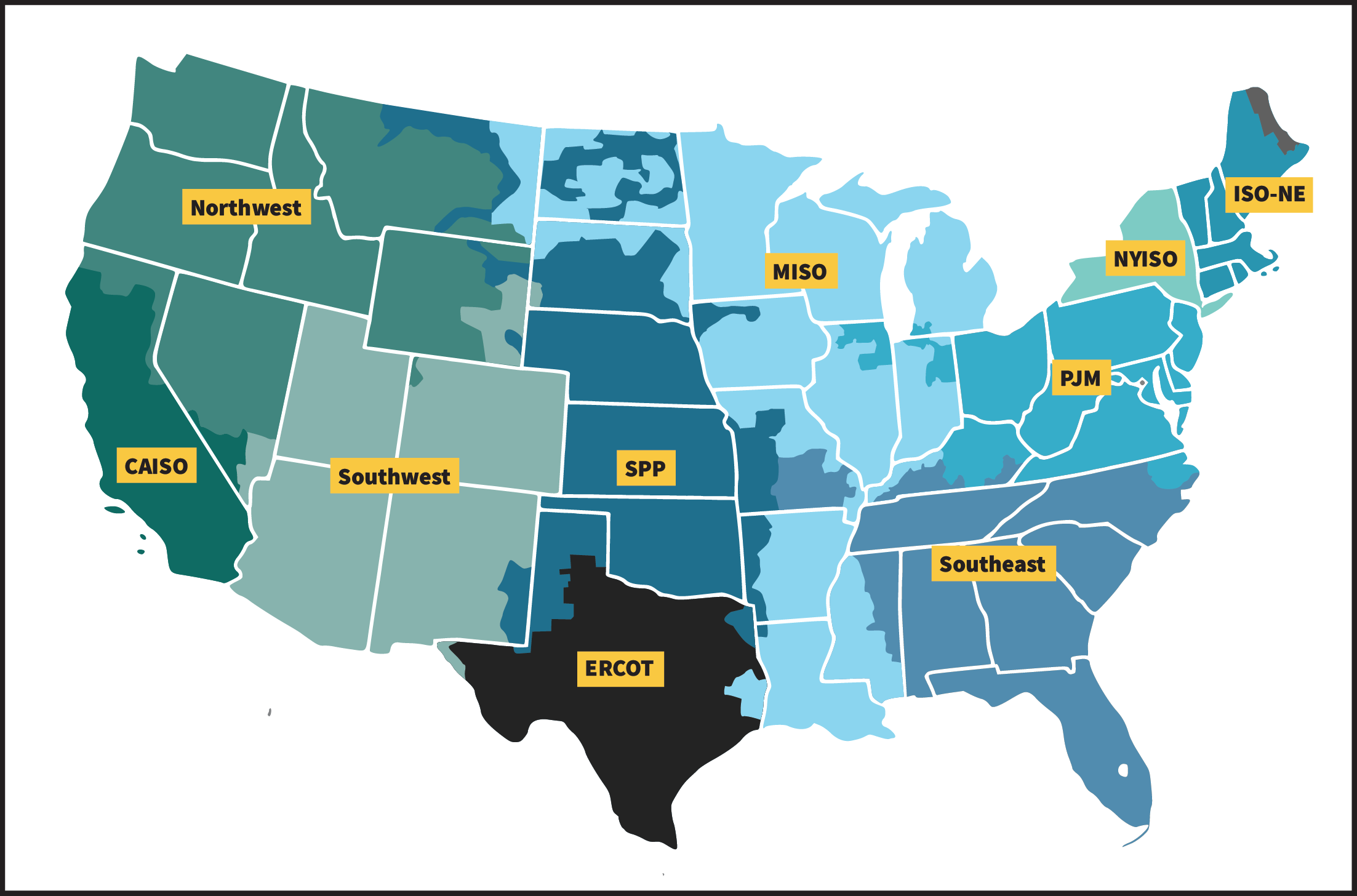
For this report, we chose to model PJM—the largest in the country in terms of peak load, customers, and total generation, spanning all or parts of 13 states and the District of Columbia and serving roughly 67 million people, or nearly 20 percent of the U.S. population. PJM also provides data and forecasts out to 2045, which is extremely helpful for modeling.
Trending in the Wrong Direction
As you can see, PJM projects that electricity consumption (blue line, left axis) is expected to nearly double by 2045, while summer and winter peaks (red and green lines, right axis) are expected to jump by almost 50 percent to 229,000 MW and 219,000 MW, respectively. Much of this growth is driven by electrification efforts and data centers.
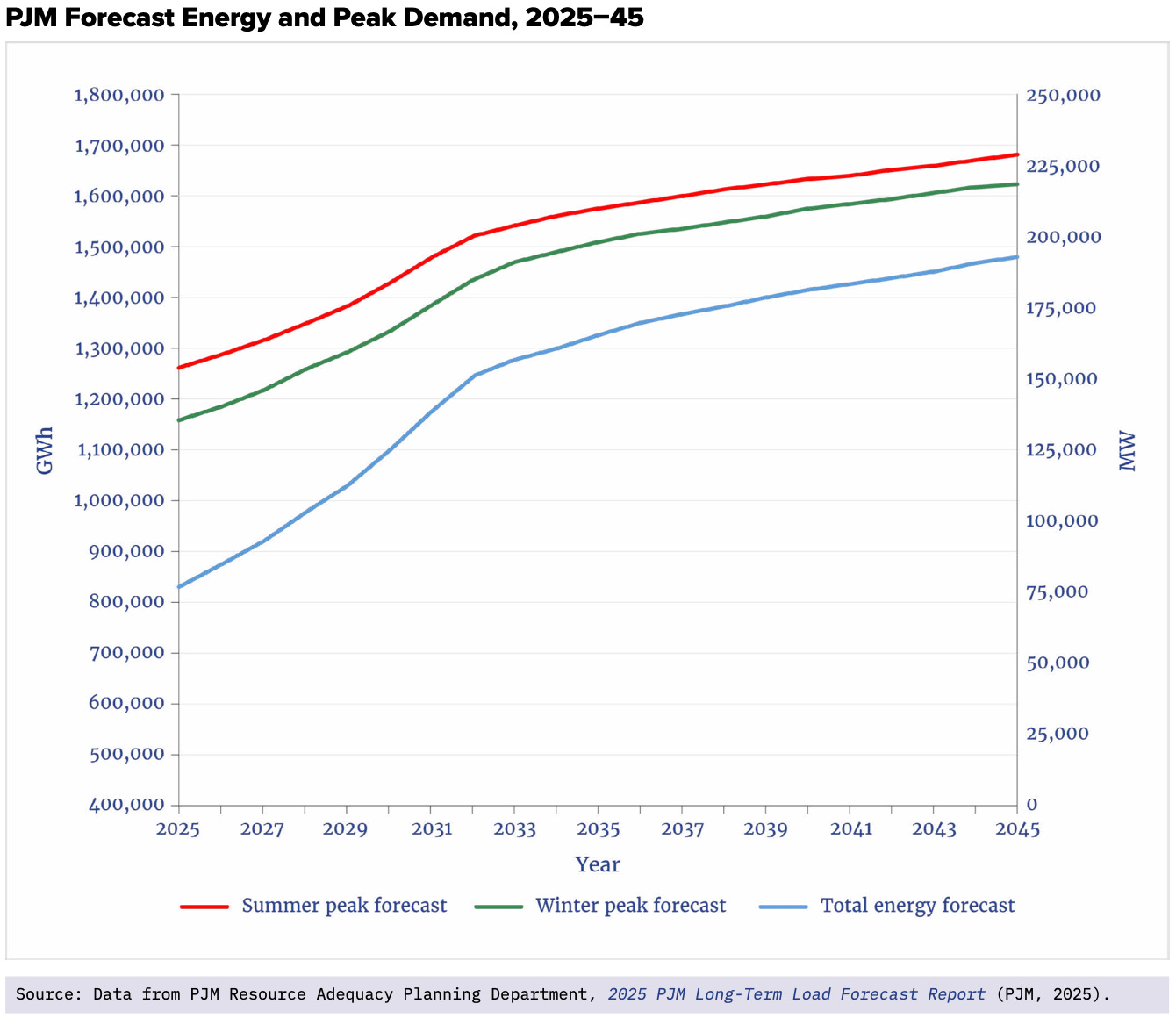
Unfortunately, PJM is already trending in the wrong direction to meet this growth in demand.
The table below shows that since 2020, PJM has lost a net of 4,500 MW of firm capacity (fossil-fuel total plus nuclear below) and replaced it with just over 17,000 MW of wind and solar.
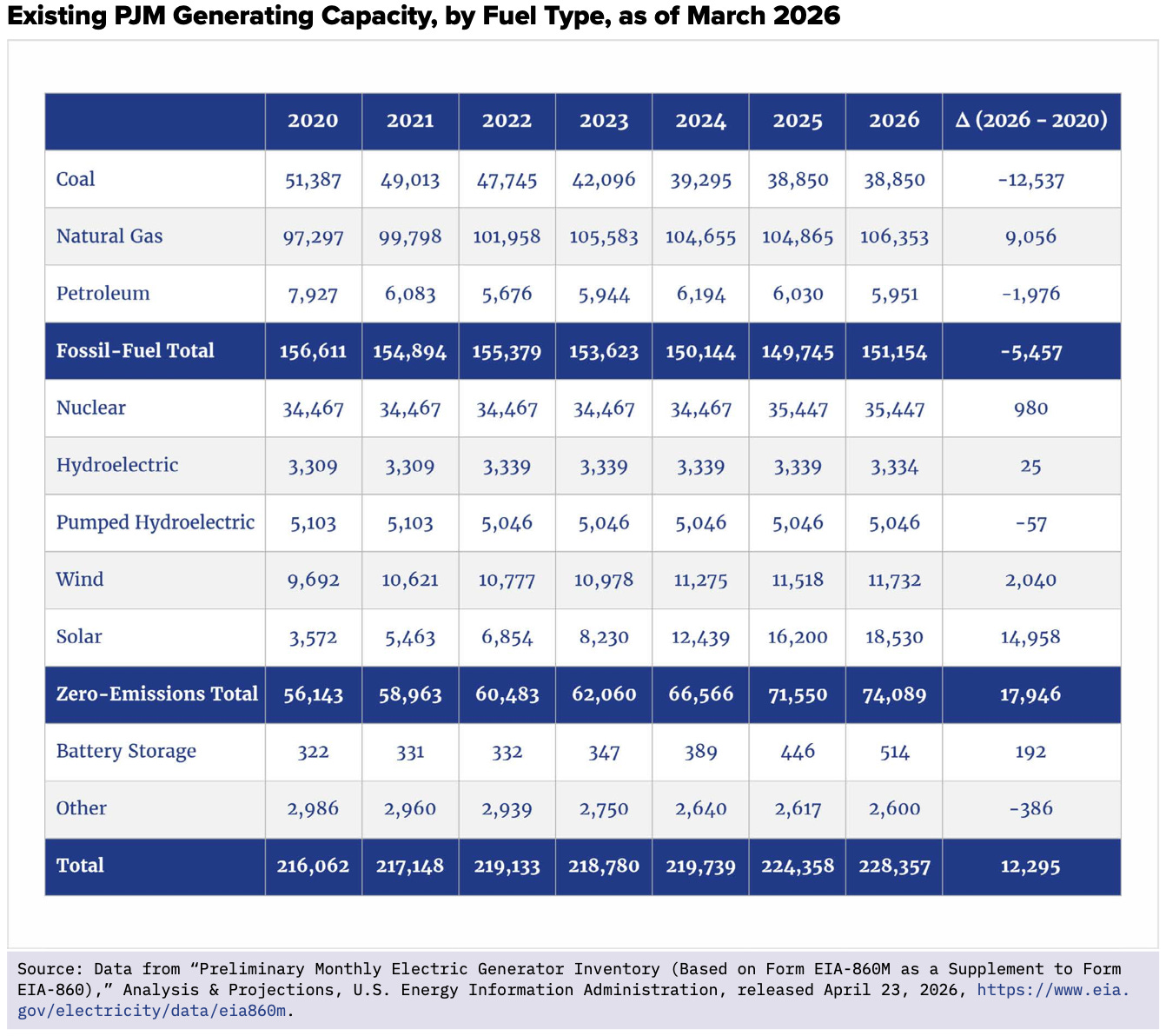
Notice that less than 200 MW of battery capacity was built during this time, so as of now, PJM has been directly replacing firm, dispatchable generators with intermittent wind and solar resources without a firming resource. With this in mind, it’s no wonder that PJM capacity auctions have come up short two years in a row.
Model Results
The report models three scenarios:
A renewable-only (RO) scenario that uses primarily wind, solar, and battery storage to power the grid. The RO scenario retires all existing fossil-fuel generators by 2040 and keeps all existing nuclear capacity online, which is a significant resource in PJM of over 35,000 MW.
A natural-gas and nuclear (NGN) scenario that uses new natural gas and nuclear facilities to meet demand. It also assumes no additional wind and solar and gradually retires existing renewable facilities as they reach the end of their useful lives. The coal retirement schedule under the NGN scenario is the same as the RO scenario, but it does not have the same retirement deadline of 2040 for existing natural gas facilities. Existing nuclear facilities are also kept online.
A modified NGN scenario with batteries (NGN+B), which differs from the NGN scenario only by utilizing battery storage as a peaking resource.
Capacity Requirements
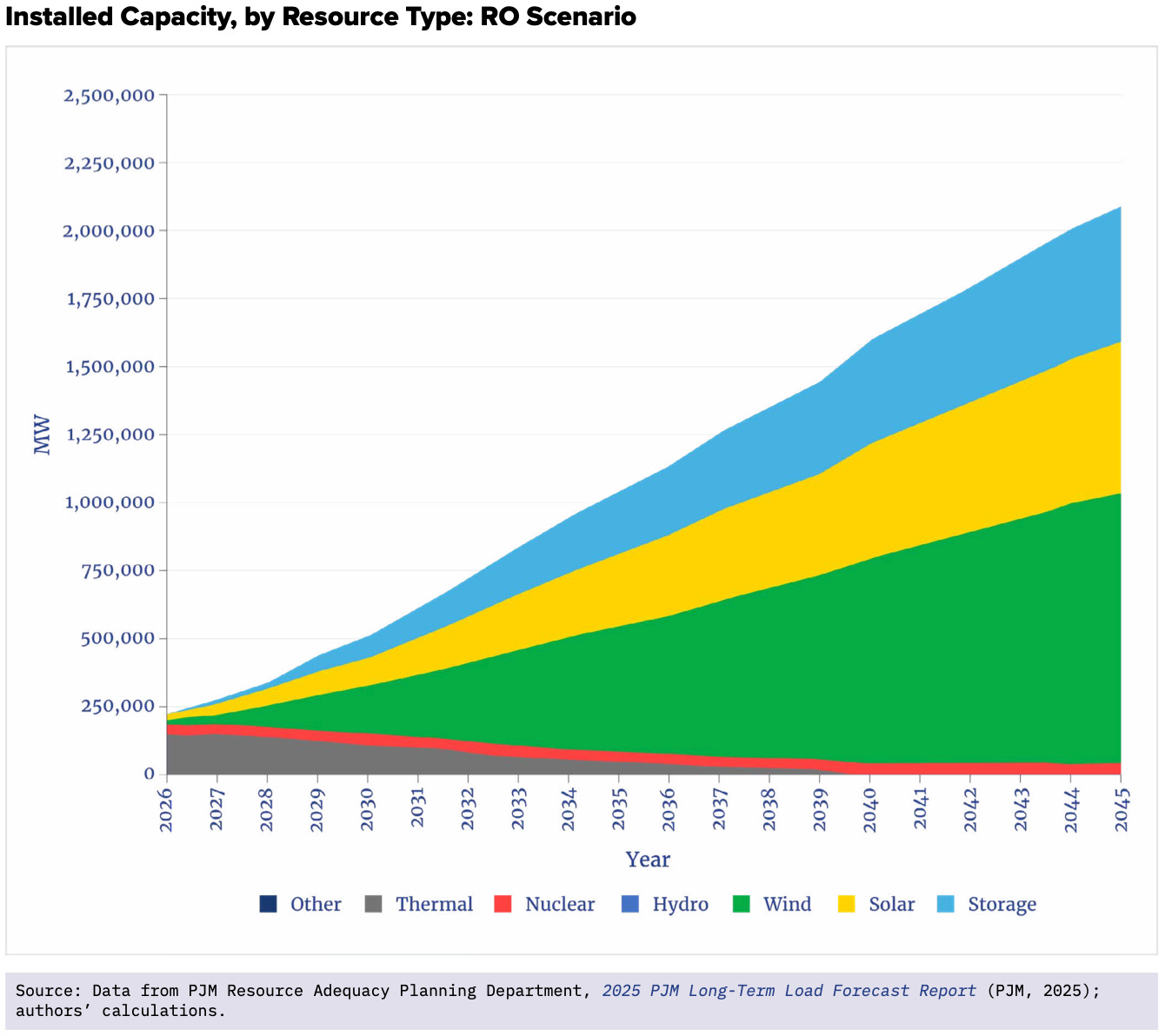
The capacity requirements for each scenario are shown in the graph below. As you can see, the current grid has just under 225,000 MW of capacity on the system. The NGN and NGN+B scenario would require 333,023 MW and 362,828 MW, respectively—an increase of 48-62 percent.
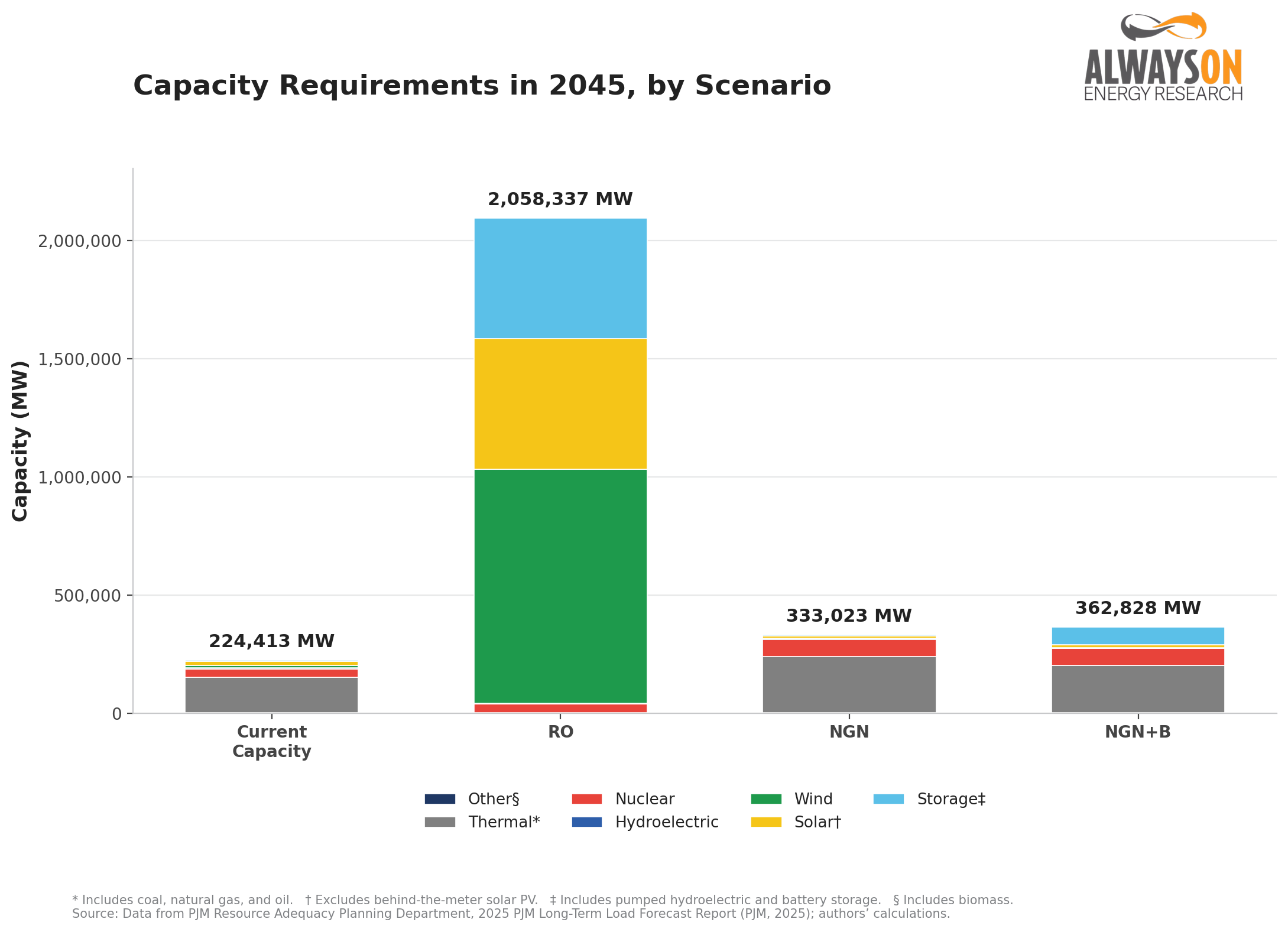
The RO scenario, on the other hand, would require a massive overbuilding of the grid, ballooning the total capacity on the system to 2,058,337 MW for an increase of over 800 percent.
The RO scenario was cost-optimized to meet demand and resulted in a need for 991,002 MW of wind, 550,657 MW of solar, and 510,702 MW of storage.
Intermittency, Droughts, and Battery Limitations Drive Capacity Needs
The annual rate of capacity additions needed to achieve this scale is likely impossible, yet it’s required to maintain reliability to compensate for intermittent generation, prolonged wind droughts, and periods of significant underperformance from the solar fleet.
The report notes historical occurrences of recent wind and solar droughts in PJM, including a 113 hour period of the wind fleet producing less than 1,000 MW of electricity in the middle of July.
This poses a major issue for battery storage and its ability to firm wind and solar generation. Battery storage does not generate electricity itself, and the majority are short-duration technologies. Because of this, “they cannot accommodate multiday periods of cloudy and windless days without duplicating energy storage systems and overbuilding the electricity grid; this in turn, raises electricity costs.”
The Cost of a Wind, Solar, and Battery PJM
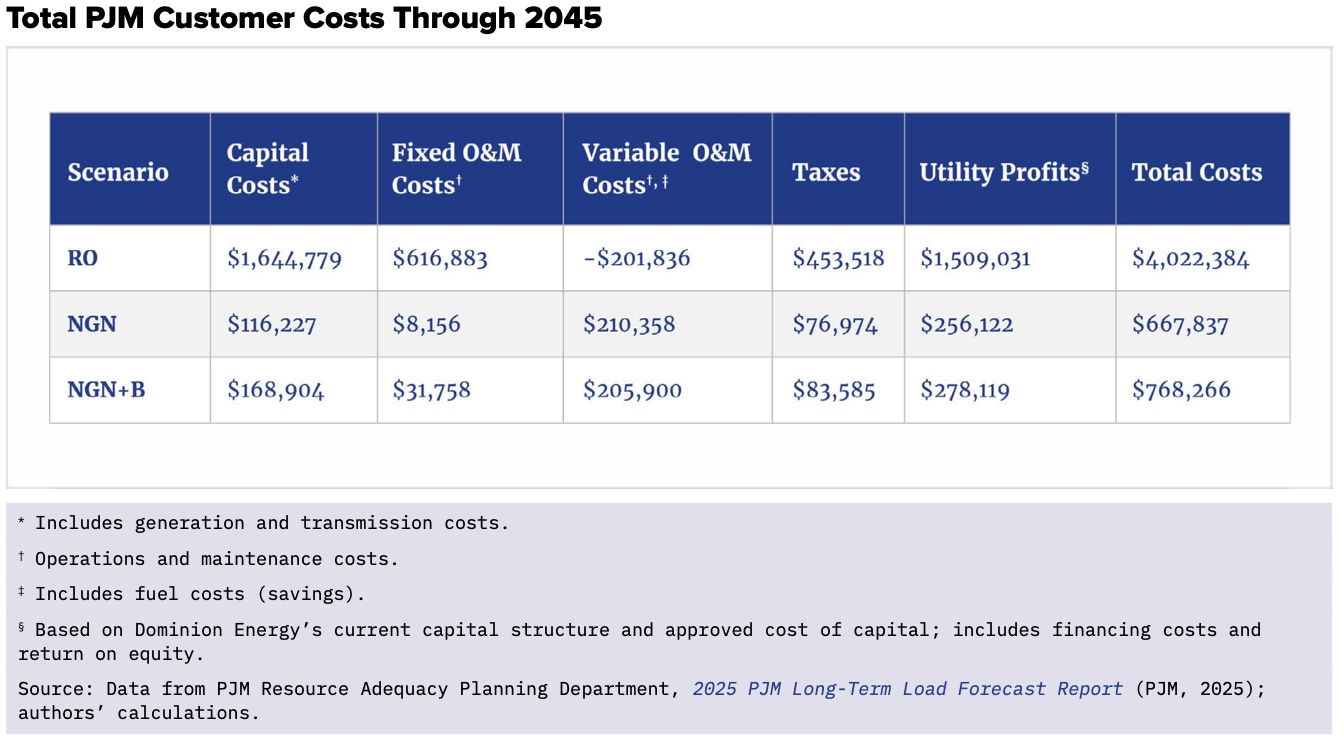
The RO scenario would cost over $4 trillion through 2045 due to the massive buildout of wind, solar, and batteries required to maintain reliability.
Needless to say, this would drive electric bills through the roof—and this is only through 2045. Due to the need to repower wind, solar, and battery facilities every 15-25 years, these costs will remain high.
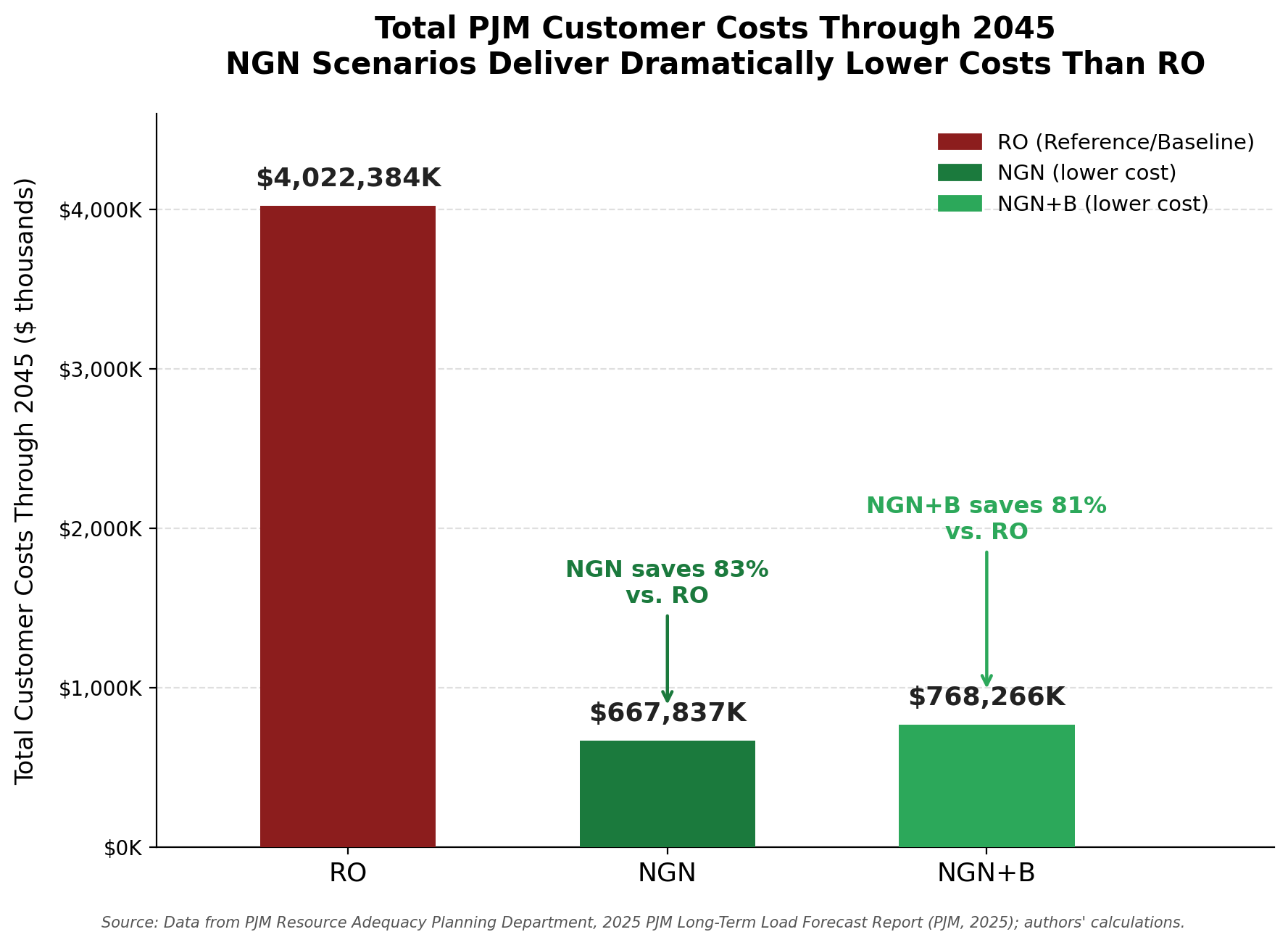
PJM consumers could save money by using natural gas and nuclear instead. The NGN scenario would be a fraction of the cost of the RO scenario at just under $668 billion—or 83 percent less than the RO scenario—because it utilizes firm, dispatchable generators to meet demand.
Adding batteries to the NGN scenario, which reduced the amount of new natural gas capacity needed, was also substantially more affordable than the RO scenario, suggesting batteries may eventually prove economical when paired with firm generation—but the NGN+B scenario was still 15 percent more expensive than simply using natural gas peaking plants.
Yes, People Are Actually Asking For This
In his thread on X, Jigar Shah, who worked at the DOE’s Loan Programs Office from 2021 to 2025 under former President Joe Biden, claimed the report was “useless” because it deliberately calculated “something no one is contemplating.” He questioned why there was no fossil fuel backup in the RO Scenario, and why we didn’t assume 20 percent demand flexibility in our assumptions—which he claims PJM is on track for by 2030.
He concludes by asserting: “Keep existing gas fleet, 20% demand response, add solar rooftop+storage, and enable backup generators, and costs land near their cheaper NGN+B scenario (~$1.4T).”
There’s a lot to say in response, but we’ll begin by asking—What planet is Jigar Shah living on? Shah may not take the calls for a “carbon-free” grid seriously, but others certainly do.
Take, for example, the 24 states (plus D.C.) that have some kind of 100 percent carbon-free or renewable energy mandate by no later than 2050, many with specific phase-out schedules for existing natural gas facilities. The Virginia Clean Economy Act (VCEA) requires utilities to phase out all fossil-fuel generation and reach 100 percent renewable electricity by 2045 and 2050. The Illinois Climate and Equitable Jobs Act (CEJA) also mandates the retiring or converting of all coal and natural gas facilities by 2045. Not to mention, the Biden administration that Shah worked for wanted a carbon-free electric grid by 2035.
Additionally, one of the nation’s largest environmentalist advocacy organizations in is the Sierra Club, which explicitly advocates for the phase-out of existing natural gas facilities in favor of a combination of wind, solar, and batteries. It also funds other organizations who promote the same agenda.
Clearly, people are contemplating a wind, solar, and battery storage future. This is what prompted the report in the first place.
Furthermore, it’s hard to ignore Shah’s claim about demand flexibility. Our report did assume small amounts of firm load modifying resources (LMRs), but there is no indication that PJM is on track for one-fifth of peak demand to be flexible by 2030—besides a “trust me bro” from Shah himself. Current levels are nowhere near that amount (only a small fraction of peak demand today), and while PJM is exploring ways to make load more flexible, the assumption that one-fifth of peak demand will be flexible by 2030 is almost as unrealistic than assuming no demand response at all.
It’s interesting to note that even with this assumption, he cites a total cost of $1.4 trillion—which is still more than double the natural gas and nuclear (NGN) scenario that doesn’t force or pay consumers to lower their energy usage.
Conclusion
Batteries may have their place on the energy grid, but that role certainly isn't firming wind and solar as a means of replacing dispatchable generation.
Wind and solar droughts are too frequent, battery storage duration is too limited, and the cost is too prohibitive to achieve the capacity buildout required. Unfortunately, these facts haven’t stopped organizations from advocating for it and states from passing legislation to enforce it.
The Battery Bubble will pop eventually. The only question is how much money we'll spend before reality catches up with the hype.

A Tale of Two Transmission Lines by Meredith Angwin
Southwest Power Pool narrowly avoids blackouts by Sarah Montalbano
Excellent summary, EBB.....Wind and solar droughts are too frequent, battery storage duration is too limited, and the cost is too prohibitive to achieve the capacity buildout required. Unfortunately, these facts haven’t stopped organizations from advocating for it and states from passing legislation to enforce it.
The Battery Bubble will pop eventually. The only question is how much money we'll spend before reality catches up with the hype.
Sadly, California has already wasted billions of dollars with the installation of 16,351 MW of 4-hour batteries as of 01 June 2026. California is also distinguished by having the first massive battery fire at Moss Landing in January, 2025. 300 MW of batteries up in smoke. Likely total cost will be about $1/2 billion. Physics is the reason I say the expenditure is wasted.
1. Batteries fail to contribute meaningful amounts of essential synchronous grid inertia like large nuclear power plants do.
2. Furthermore, the short circuit capability for a few milliseconds is orders of magnitude less than nuclear power plants.
3. Finally, batteries are ideally suited for resistive loads with a power factor of 1.00. On the other hand, the dominant load for power grids are electric motors with a power factor of 0.80. That means wasted energy when employing batteries. It is acceptable for household loads with Tesla PowerWalls. However, this inefficiency is unacceptable for a massive power grid.
I am seeing a transition in batteries from a purely renewable driven device to a market tool completely separate from renewable energy. I am wondering if you have looked at that? They do play well with gas turbines keeping them in optimum heat rate output during lower loads, and reducing ramp stress during super peak. Thoughts?