
B.S. Baseline Modeling
The Bait & Switch budgeting tactic used to deceive the public about the federal regulations, wind, and solar.


Whenever you see a regulatory agency like the Environmental Protection Agency (EPA) or a utility company crow about how much an energy proposal or regulation will save or cost Americans, the first thing you should do is ask: “Oh yeah? Compared to what?”
It’s important to ask this question because these entities never report the true cost of a proposal compared to today’s costs, but instead, they compare the costs to some imaginary future baseline scenario that is often even more expensive.
This deceptive bait-and-switch tactic allows utilities and regulatory agencies to hide the true costs of their onerous regulations or integrated resource plans in a B.S. baseline. It also allows these entities to dishonestly claim their preferred policies will save energy consumers money—when in reality, they won’t
In this week’s episode of Energy Bad Boys, we pull back the curtain on how the EPA used a B.S. Baseline to hide the true (and massive) costs of its regulations on greenhouse gas emissions from existing coal and new natural gas power plants.
What’s the Bait & Switch (B.S.) Tactic?
Imagine you were at Best Buy browsing around, and you saw an advertisement for two TVs—the one on the left has a price tag of $800, and the other on the right has a price tag of $500. The sign reads: “Save $300 by choosing the one on the right!”
Sure, you can save $300 by buying the TV on the right, compared to buying the one on the left, but ultimately, you understand that you’re still spending an extra $500. You could save even more ($500) by not buying a new TV in the first place. These are the kinds of bait-and-switch shenanigans used by regulatory agencies and utilities to sell their energy proposals to the public.
To help understand how this relates to energy modeling, it helps to look at another example involving a government budget.
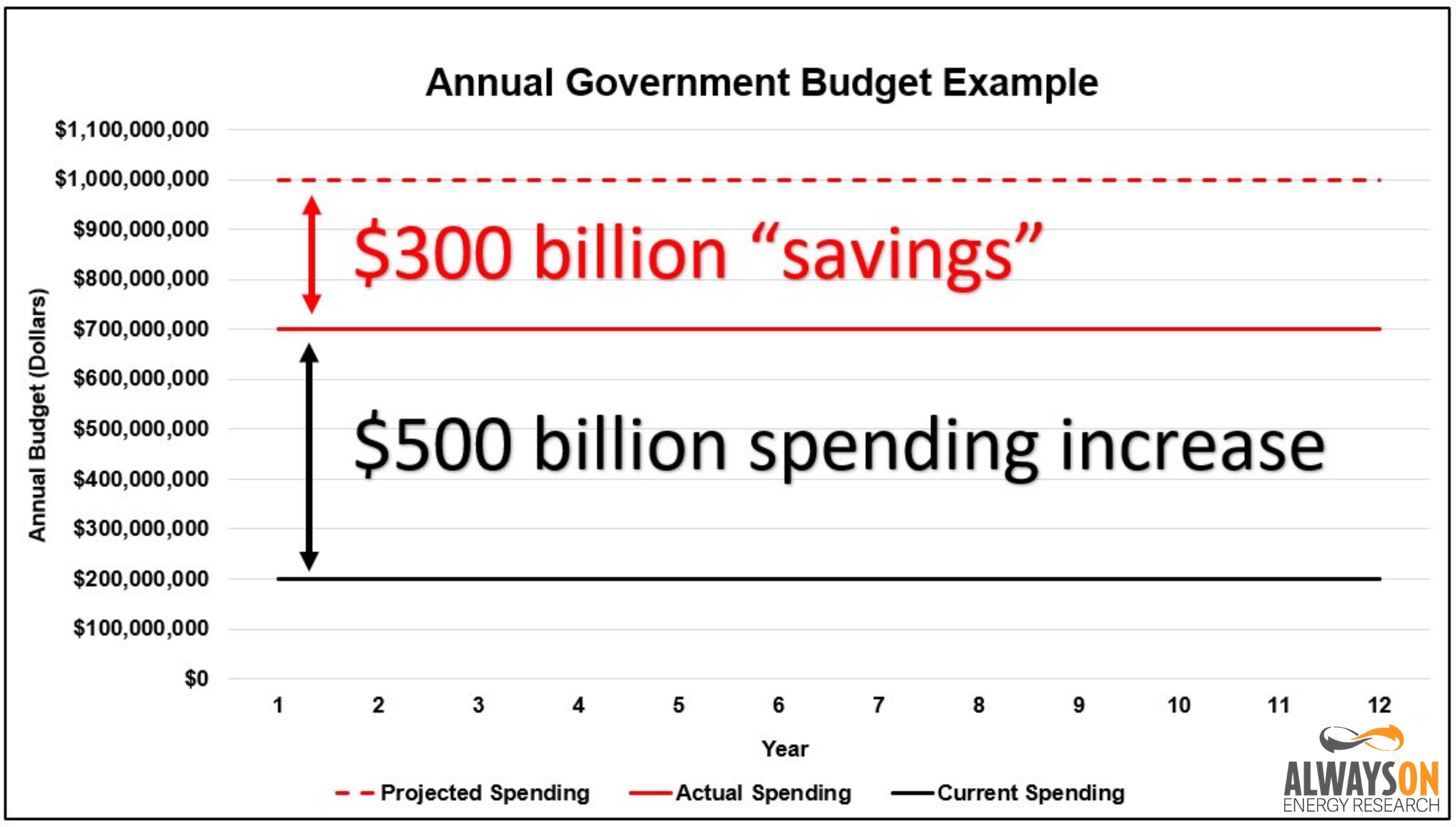
Let’s say the federal government currently spends $200 billion per year on government programs, but some lawmakers want to increase spending to $1 trillion to pay for more government programs. Ultimately, Congress agrees to spend a total of $700 billion per year instead of $1 trillion.
Most people would probably look at this budget and agree that it increases spending by $500 billion per year, but spending advocates would argue that this bill saves $300 billion per year. This is only true if you read the fine print that says, “compared to the baseline cost estimate that assumed a total of spending $1 trillion.”
The EPA Bait & Switch: the Base Case vs. the Final Carbon Pollution Standards (CPS)
For the last several weeks, we have been working on comments examining the Trump Administration’s proposal to repeal President Biden’s EPA finalized regulations on greenhouse gas regulations on existing coal and new natural gas plants.
Before we could quantify the benefits of repealing these rules, we had to calculate what the rules actually cost.
Ordinarily, it would seem reasonable to assume that the benefits of reversing a regulation could be determined by reversing the estimated cost of complying with said regulation.
When the Biden EPA finalized its regulations, they claimed the rules would only cost Americans $19 billion in additional costs, and that these compliance costs would be far outweighed by the benefits of fewer emissions of criteria pollutants and greenhouse gases.
But there was a major problem with their claim: Almost all of the actual compliance costs of the rules were buried in a B.S. Baseline.
The B.S. Biden Baseline is a scenario created by the Biden EPA in 2023 that assumed almost all of the changes to the power generation fleet in the next two decades would be due to the subsidies in the Inflation Reduction Act (IRA), and state wind and solar mandates, not the Biden administration’s greenhouse gas regulations.
Based on our evaluation (let’s be real, Mitch did this part) of the EPA’s slew of Excel spreadsheets, the Biden Admin’s B.S. Baseline accounted for 95 percent of the changes in generation capacity from the MISO grid in 2025 through 2055, compared to the final rules, which you can see in the table below.
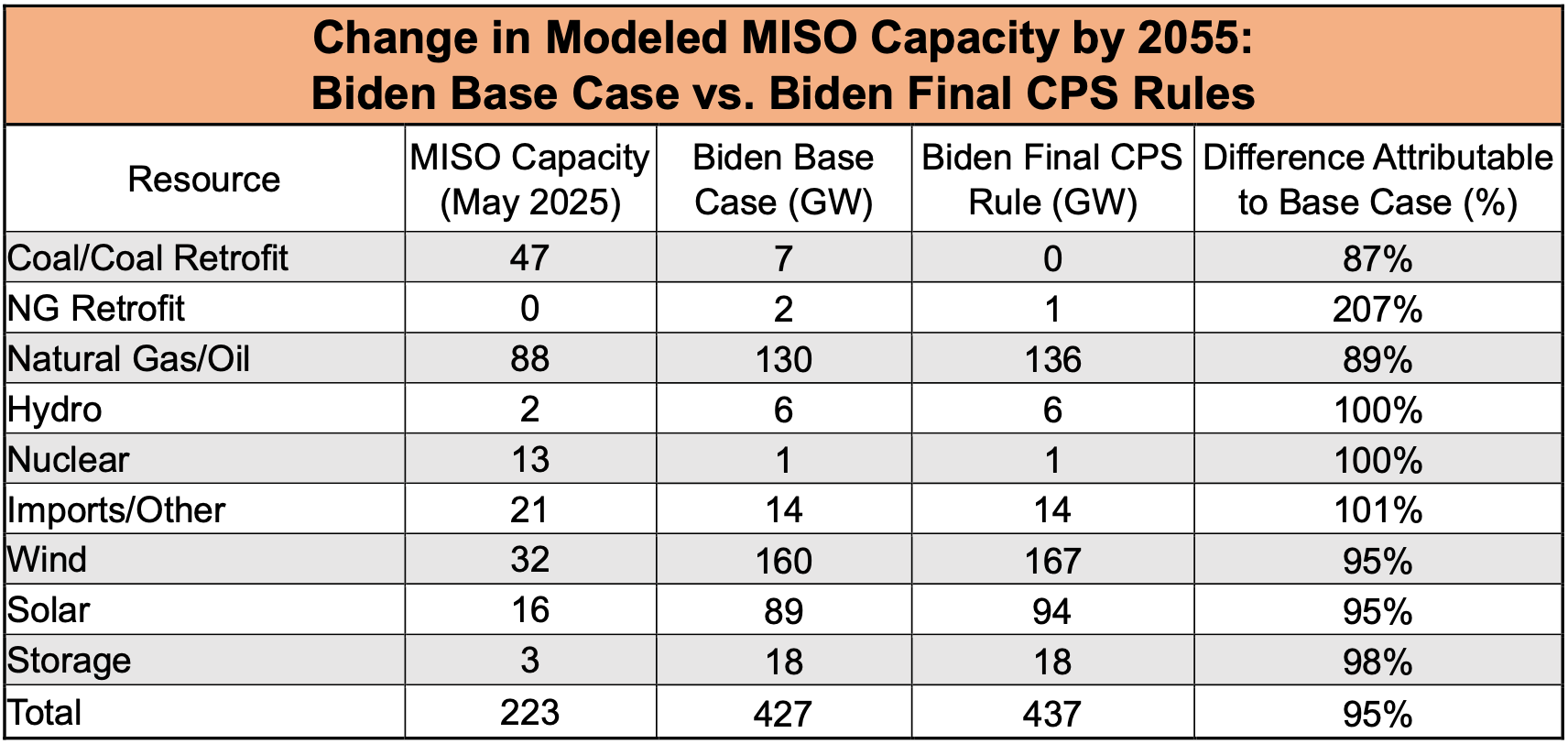
Because the Biden administration hid almost all of the new generation capacity in its B.S. Baseline, nearly all of the costs associated with building and operating this generating capacity were hidden, as well.
Burying Costs in the B.S. Baseline
The Biden administration claimed that its final power plant would only increase costs by $19 billion over a 24-year period, spanning from 2024 through 2047, using a 2 percent discount rate. However, this modest compliance cost is entirely due to the fact that most of the expenses for the modeled MISO grid in the Biden Final CPS Rules IPM output files are incurred in the Biden Base Case.
The graph below shows the costs of building and operating the MISO grids outlined in the Biden administration’s B.S. Baseline and final regulations. Our modeling indicates that the modeled MISO grid in the Biden Baseline would cost $362.1 billion, using the subsidy phaseout timeline established in the One Big Beautiful Bill Act, and the final Biden regulations would cost $404.1 billion.
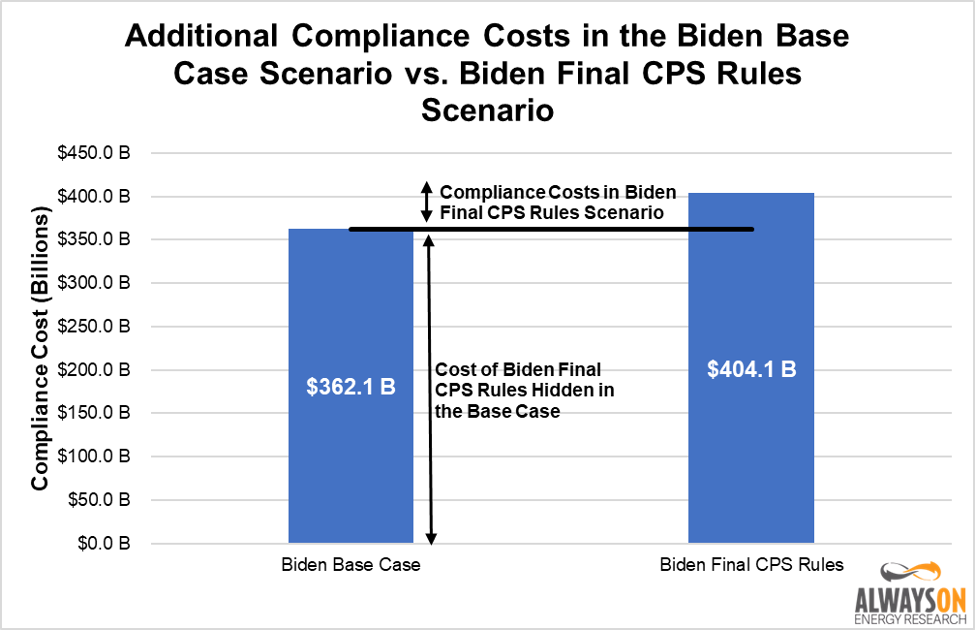
As a result, the true cost of building and operating the MISO grid under the Biden rules envisioned in Biden’s regulatory impact analysis would be $404.1 billion, but the administration would only consider $42.9 billion as compliance costs.
Here we need to note that we got different numbers than the EPA for a number of reasons. First, the subsidies for wind and solar are projected to be reduced now due to the Trump administration’s reduction in tax credits for these energy sources. Secondly, the EPA used capital cost assumptions from the National Renewable Energy Laboratory’s Annual Technology Baseline, which we have criticized before as being overly optimistic.
Conclusion
Long story short, the B.S. Baseline used by the Biden administration hid 90 percent of the costs of its regulations. Because the Biden Base Case is responsible for the vast majority of the changes observed in the modeled MISO grid in the Biden Final CPS Rules, it is responsible for driving the vast majority of the cost of the changing resource portfolio.
Therefore, it is incredibly misleading to suggest that the Final CPS Rules would be cost effective, since the 90 percent of the costs are hidden in its baseline modeling. This is called a Bait & Switch—and it’s completely B.S.
Completely off your main topic, but the thing that jumped out at me is that Biden's plan had nuclear going from 13 GW to 1 GW. With reactors capable of operating for 80 years or more, this is completely unconscionable.
Yet another reason to be glad they're out. Now let's keep them out.
thank you for this. it seems, at least to someone on the sidelines, that Mr Zeldin is pushing things in a more sensible, and cost effective manner in this administration. Hopefully, all to be enshrined going forward